Projector vs TV for home theater in 2026.
2026-09-21 · Obsidian Audio Video · Houston
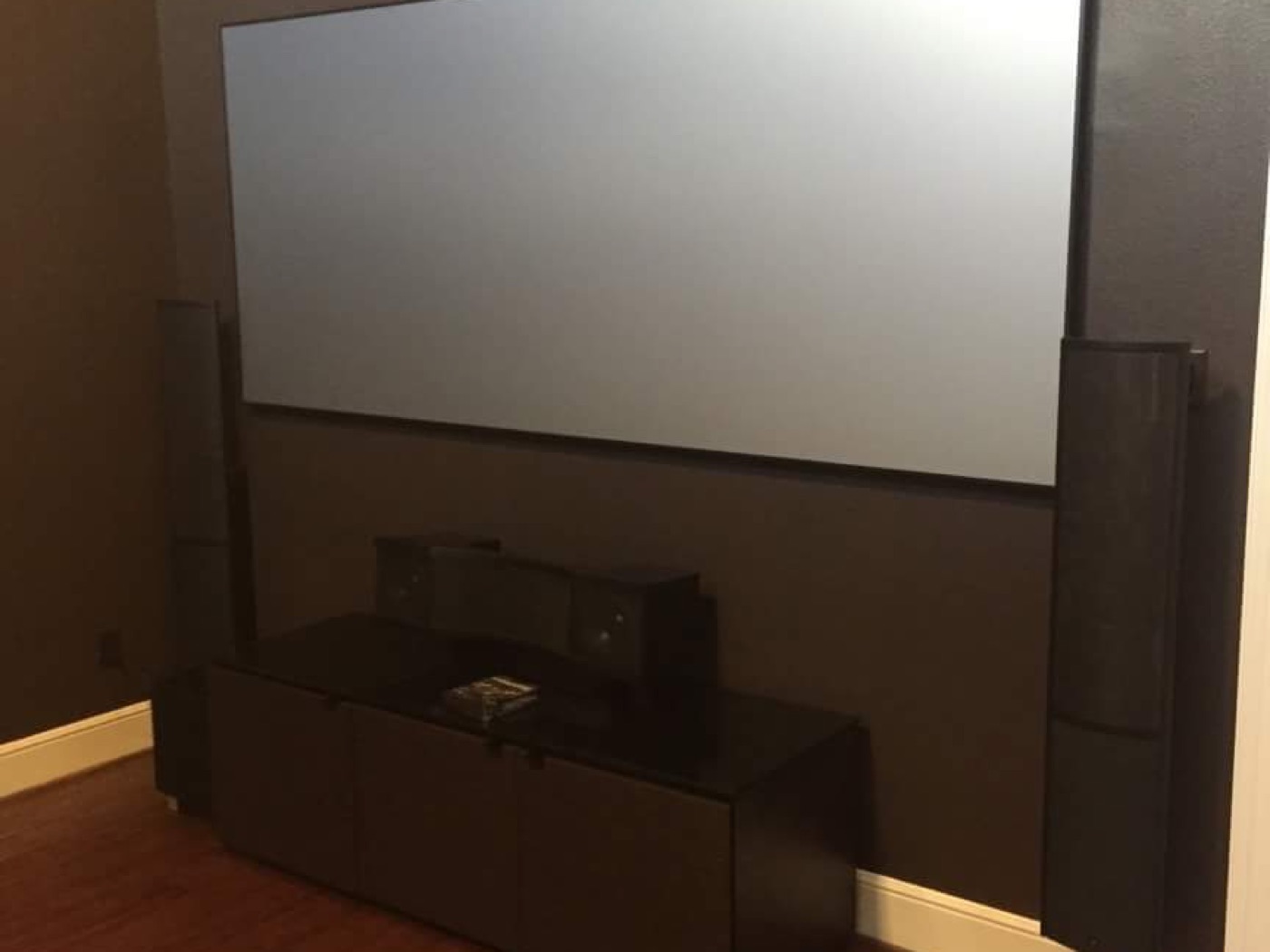
The projector vs TV debate used to be simple: projectors for big screens, TVs for everything else. In 2026, with 100-inch TVs available and laser projectors hitting 4,000 lumens, the decision is more nuanced. We design home theaters across Houston from the Heights to Sugar Land, and the projector vs TV question comes up on every single project. The answer depends on your room, your budget, and how you watch. Here's the honest breakdown from an integrator who installs both — and doesn't get a commission from either side.
When a projector wins
Projectors still dominate the dedicated theater market, and for good reason. Nothing else delivers the immersive, larger-than-life experience of a 120-inch or 150-inch screen. Here's where projectors pull ahead:
- Screen size: Projectors still win for screens over 110 inches. A 120-inch screen with a 4K laser projector creates an immersive experience no TV can match. A 150-inch screen with a Sony VPL-XW5000ES or Epicon laser projector fills your field of vision in a way that even a 100-inch TV can't. The experience of watching "Dune" or "Top Gun: Maverick" on a 150-inch screen is fundamentally different from watching on a 85-inch TV — it's a theater experience, not a TV experience.
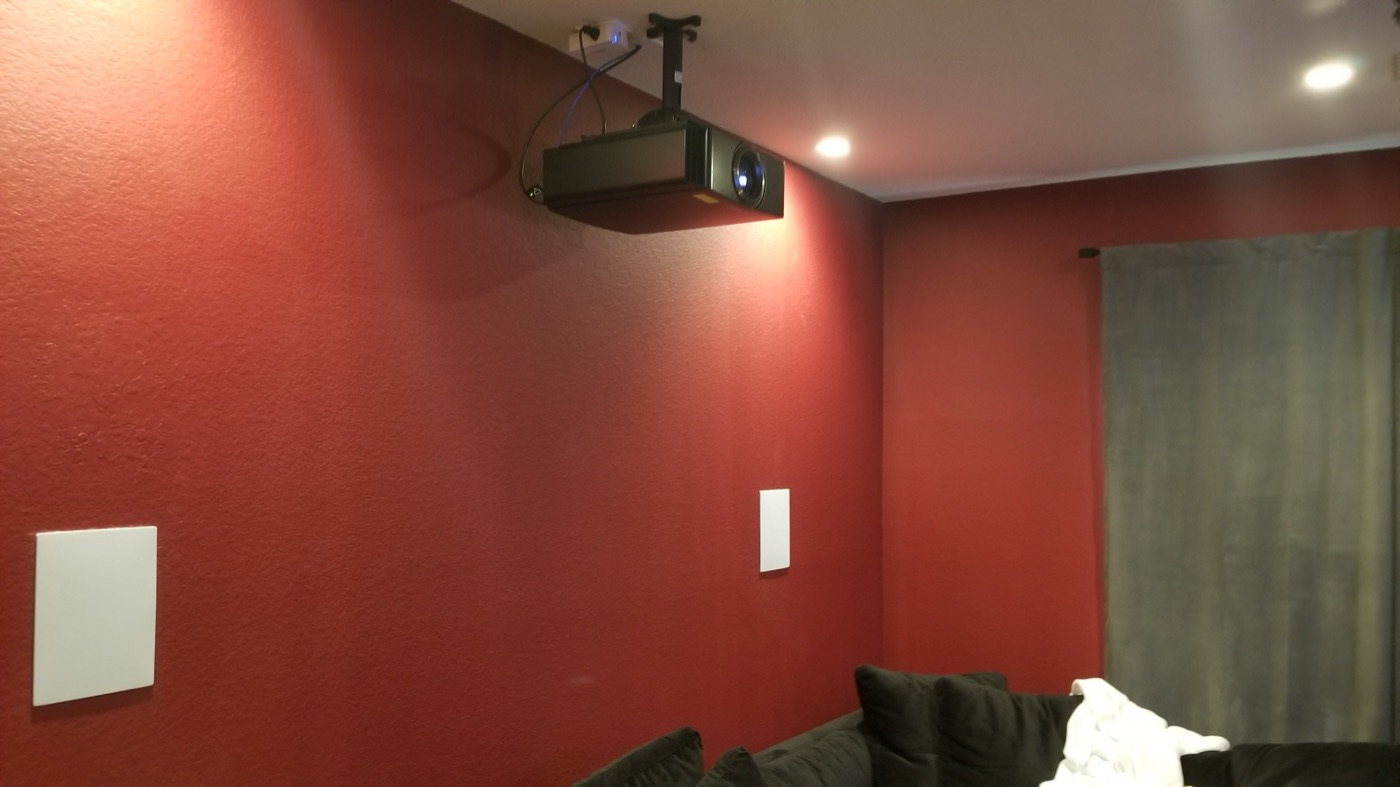
- Dedicated theaters: A light-controlled room with dark walls, dark ceiling, and controlled lighting is a projector's natural habitat. In a dedicated theater room — which we build in homes across Houston from Bellaire to Kingwood — a projector delivers the best possible image quality for the price. Black levels are excellent because the room is dark, and the contrast ratio of a good laser projector (1,000,000:1 dynamic contrast on the Sony VPL-XW6000ES) rivals or exceeds most TVs.
- Value per inch: Very large TVs get expensive quickly, while a projector and screen scale to 120 inches and beyond for less. For screens above 100 inches, projectors are usually the more cost-effective choice.
- Acoustic transparency: A woven acoustically transparent screen (Stewart StudioTek or Screen Innovations Maestro) lets you place the center speaker behind the screen, exactly where it should be for proper dialogue imaging. With a TV, the center speaker goes above or below — never behind — which compromises the soundstage. This is why every serious dedicated theater uses a projector and an AT screen.
When a TV wins
TVs have gotten dramatically better — and dramatically larger — in the last five years. For many Houston homes, a large TV is the better choice. Here's when a TV wins:
- Brightness: Modern OLED and mini-LED TVs produce 2,000+ nits. The Samsung Neo QLED 8K hits 4,000+ nits in HDR highlights. Even the best projectors max out at 300–500 nits on a standard screen. In a room with any ambient light — a living room with windows, a media room with can lights on — a TV looks better. Projectors simply can't compete in a room that isn't fully light-controlled.
- Living room theaters: If your "home theater" is also your living room, a large TV works better. Most Houston living rooms have windows, light-colored walls, and ceiling lights. A projector in that environment looks washed out and dim. A 85-inch or 98-inch TV looks vibrant and punchy. We install Samsung Neo QLED and LG OLED TVs in living rooms and media rooms across Houston — they're the right tool for the job.
- Contrast: OLED TVs produce true blacks — each pixel turns off completely. No projector can match the contrast of an OLED in a non-dark room. The LG G4 OLED and Samsung S95D OLED deliver perfect blacks and infinite contrast. In a room with any ambient light, a projector's blacks look gray — the screen can't absorb the ambient light. An OLED TV's blacks stay true black regardless of room light.
- Simplicity: A TV is simpler — mount it, plug it in, done. A projector requires a screen, a mount, cable runs to the projector location (usually ceiling-mounted), and in many cases a separate audio system. For a secondary viewing space — a bedroom, a casual media room — a 75-inch or 85-inch TV is the right call.
- Gaming: If gaming is a primary use case, a TV wins. Modern TVs have 120Hz or 144Hz refresh rates, HDMI 2.1 with VRR (variable refresh rate), and input lag under 10ms. Projectors have higher input lag and lower refresh rates. For competitive gaming, a TV is the only option.
The Houston recommendation
Houston's homes and climate factor into this decision. Here's what we recommend based on the room:
- Dedicated theater room (light-controlled, no windows): 4K laser projector + 120-150 inch screen. This is where projectors shine — literally. A native 4K laser projector with a quality 130-inch screen delivers a theater experience that no TV can match.
- Living room / media room (ambient light, windows): 85–98 inch mini-LED or OLED TV. A quality 83–85 inch mini-LED or OLED looks fantastic in a room with ambient light. No screen to install, no projector to ceiling-mount, no lamp to replace.
- Outdoor / patio: For Houston's year-round outdoor living, a weatherproof TV (SunBrite or Samsung Terrace) is the only option. Projectors outdoors in Houston's humidity and heat are a maintenance nightmare. A weatherproof TV sized for a covered patio is the right call.
What drives the cost
The main cost factors for each approach:
- Projector system: the projector, the screen (fixed or motorized drop-down), the mount, cabling and installation.
- TV system: the TV size and panel type, the mount, cabling and installation. Simpler, usually cheaper at moderate sizes, and no light source to replace.
The projector costs more over time, too. Laser projectors last 20,000–30,000 hours before the light source degrades — that's 10+ years of normal use. But if the light source needs replacing, it is a significant repair. A TV's panel lasts 50,000+ hours with no maintenance. For a dedicated theater, the projector's image quality advantage justifies the cost. For a media room, the TV's simplicity and brightness win.
The bottom line
If you're building a dedicated theater in a Houston home — a room with no windows, dark walls, and controlled lighting — get a projector. The immersive experience of a 120+ inch screen is the whole point of having a theater. If you're upgrading a living room or media room, get the largest TV that fits your wall and budget. Both are excellent in 2026. The "projector vs TV" debate isn't about which is better — it's about which is better for your room. Call us at 346-357-5323 and we'll help you figure out which one that is.
Designing a home theater? Explore home theater installation or call 346-357-5323.