Home theater acoustics: why your room sounds bad.
2026-09-21 · Obsidian Audio Video · Houston
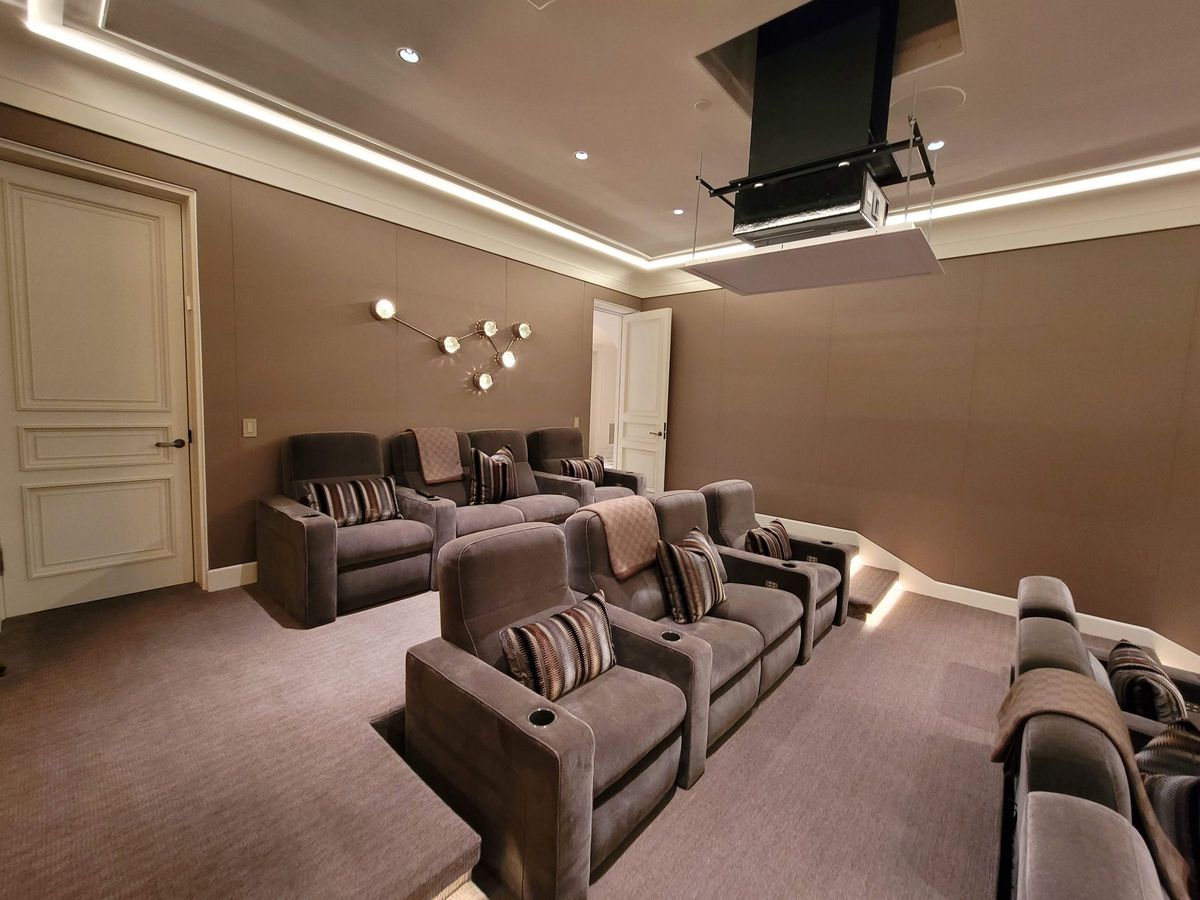
You can spend a fortune on speakers and a projector and still have a home theater that sounds terrible. The room — its dimensions, surfaces, and acoustic properties — has more impact on sound quality than any piece of equipment you can buy. A modest system in a properly treated room can outperform a far more expensive system in an untreated room. Open-concept floor plans and hard-surface finishes, common in newer Houston construction, work against acoustic clarity.
Why most rooms sound bad
Sound is physical energy moving through air. When it hits a hard surface — drywall, glass, tile, hardwood — it reflects back into the room. These reflections arrive at your ears milliseconds after the direct sound from the speakers, creating comb filtering (peaks and nulls in frequency response), smearing stereo imaging, and muddying dialogue. In a typical Houston media room with drywall walls, a sheet-rock ceiling, and tile or hardwood floors, the reverberation time (RT60) can exceed 0.8 seconds — nearly double what THX and Dolby recommend for a dedicated theater.
Common acoustic problems in Houston homes:
- Square or cube rooms: Equal or near-equal dimensions (e.g., 20×20×10) create standing waves that cause boomy, uneven bass response. Watch for this in bonus rooms and media rooms with near-equal dimensions.
- Hard floors: Tile and engineered hardwood — standard in Houston new construction — create strong first reflections that bounce sound directly to the listening position.
- Large windows: Houston homes feature extensive glazing for natural light. Glass reflects high frequencies and creates a harsh, bright character that fatigues your ears during extended viewing.
- Low ceilings: Many Houston tract homes have 9-foot ceilings — lower than ideal for a dedicated theater. Low ceilings create early reflections that muddy the midrange and compress the sense of sonic height that Dolby Atmos relies on.
- Open-doorways and hallways: Open-concept designs let bass energy leak into adjacent rooms, making the subwoofer seem weaker than it is and creating uneven low-frequency response.
How to fix it: a systematic approach
Acoustic treatment is not about covering every surface in foam. It is about targeting the specific reflections and resonances that degrade sound quality. Here is the approach we use in every Houston home theater installation:
- Treat first-reflection points: Use the mirror method — sit in the primary listening position and have someone slide a small mirror along each wall and the ceiling. Wherever you can see a speaker reflected in the mirror, that is a first-reflection point. Treat those areas with 2-inch fiberglass acoustic panels (such as GIK Acoustics or ATS panels). They are usually the single biggest improvement in clarity and imaging.
- Install bass traps: Low-frequency energy builds up in room corners. Place corner bass traps (mineral wool or rigid fiberglass, 4-inch minimum) in at least the two front corners behind the speakers. For rooms with persistent bass problems — common in slab-foundation Houston homes where bass vibrations couple directly into the structure — consider traps in all four corners.
- Add a large area rug: If the room has hard flooring, a thick area rug (8×10 or larger) with a dense felt pad underneath absorbs floor reflections and reduces reverberation. This is especially important in Houston homes with tile or stained concrete floors.
- Use rear-wall diffusion: Unlike absorption panels, diffusion scatters sound rather than absorbing it. A diffuser on the rear wall maintains a sense of sonic spaciousness and "liveness" without the harsh reflections. Quadratic residue diffusers (QRDs) are a common professional choice.
- Seal the room: Weatherstrip the theater door, add a solid-core door (not hollow), and seal any gaps. A sealed room gives your subwoofer predictable pressurization and dramatically improves bass impact — especially important on Houston slab foundations where the room needs to act as a sealed enclosure.
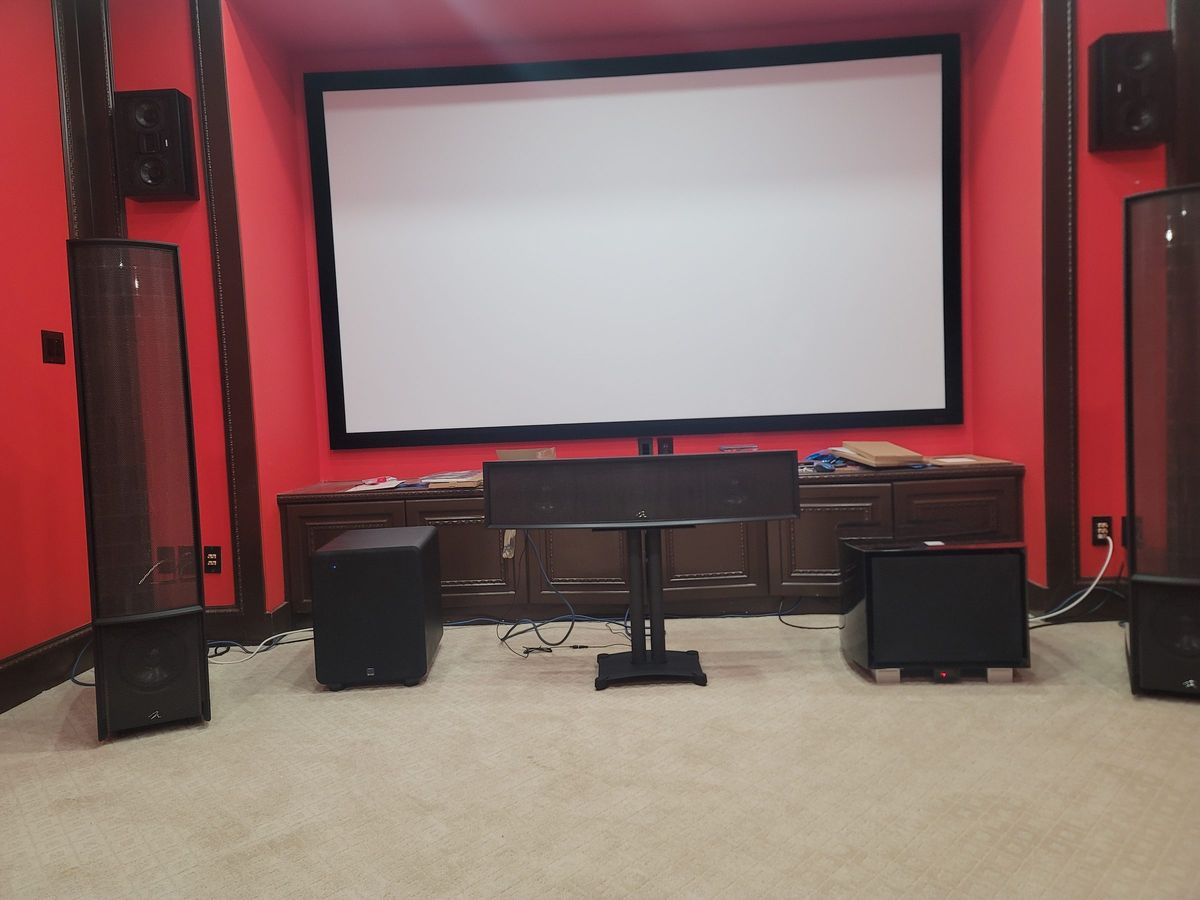
What about acoustic panel aesthetics?
A frequent concern from homeowners: "I don't want my room to look like a recording studio." Modern acoustic panels come in fabric-wrapped finishes that can match your wall color, and companies like GIK Acoustics and Vicoustic offer panels with printed artwork or custom fabric options. In a dedicated theater room, dark-colored panels on the side walls actually enhance the perceived contrast of the projector screen — a practical as well as acoustic benefit.
The humidity factor
One Houston-specific consideration: acoustic panels made from Owens Corning 703 fiberglass or mineral wool are stable in our humidity, but foam-based products (like Auralex) can degrade over time in high-moisture environments. If your theater is in a room that is not consistently climate-controlled — such as a converted garage or a room over a detached garage — opt for fiberglass-based panels rather than foam. They cost slightly more but will last decades in Houston conditions.
Building a home theater? Explore home theater design or call 346-357-5323.