
Related Guide
Commercial Video Wall Planning Guide
Commercial Outdoor Video Walls in Houston: Planning a Large Event Display.
A large outdoor display is a complete engineered system. Structure, brightness, pixel pitch, processing, power, weather exposure, content workflow, audio, control, network connectivity, and future service access all influence the final result.
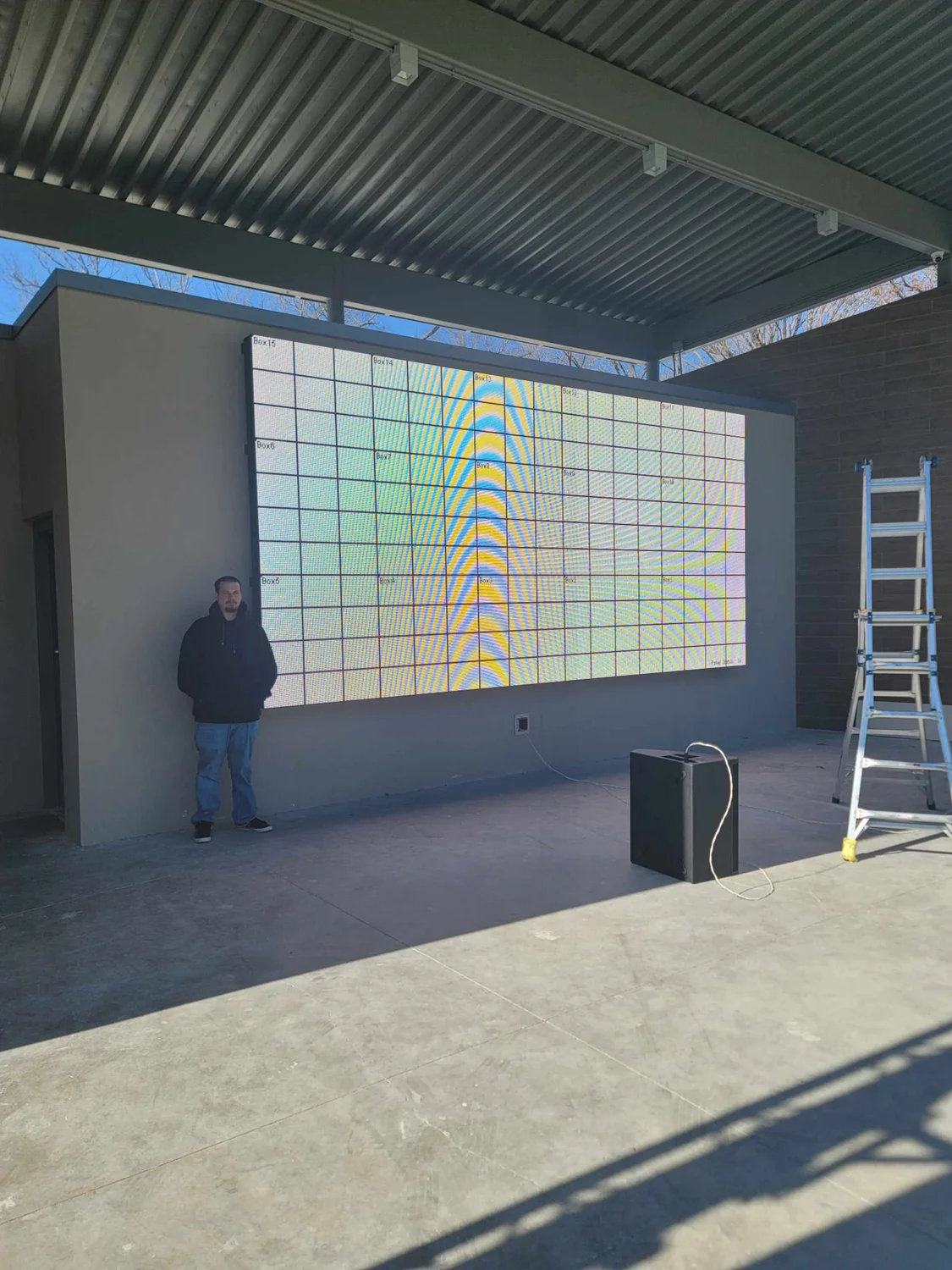
Large-format outdoor display design
Begin with the audience, viewing distance, and content.
A display for a restaurant patio, event venue, outdoor training area, worship environment, sports property, or public gathering space may need to show very different content. Live video, presentation graphics, scoreboards, digital signage, sponsor content, camera feeds, and text each place different demands on brightness, resolution, processing, and viewing distance.
The screen size should be developed from the farthest and closest viewers, not selected only because a larger number sounds impressive. Content readability, camera framing, mounting height, architectural scale, sightlines, and local brightness all matter.
Direct-view LED and LCD video walls have different strengths.
LCD video walls can produce high-resolution images and may suit protected applications where seams are acceptable. Direct-view LED can create a seamless canvas at very large sizes and is commonly considered for outdoor environments, but pixel pitch, brightness, module service, processing, structural support, and calibration must be engineered carefully.
Pixel pitch should match the real viewing distance. A very fine pitch can increase cost without producing a visible benefit for distant viewers. A coarse pitch can reveal pixel structure when the audience is too close.
Structure, wind, heat, and water are part of the AV design.
The display, mounting system, service structure, cladding, cabling, and weather protection must be coordinated with qualified structural, electrical, architectural, and construction professionals. Outdoor systems need drainage, ventilation, corrosion planning, access, and a clear boundary between weather-rated and conditioned equipment.
Power should account for startup behavior, normal and maximum load, distribution, disconnects, grounding, surge protection, service access, and the local electrical design. Sensitive processors, switches, control equipment, and source devices are often better located in a conditioned rack.
Content processing and signal transport define what the canvas can do.
A large display may need scaling, windowing, multiple sources, aspect-ratio management, live camera feeds, graphics, signage playback, or operator presets. The processor and control system should expose the workflows the staff actually needs rather than every possible technical adjustment.
Signal transport may use fiber, copper, SDI, HDMI extension, or AV-over-IP. The correct path depends on distance, resolution, latency, network design, redundancy, environmental conditions, and service expectations.
Audio should be designed for the audience—not simply attached to the screen.
Large outdoor spaces need speech intelligibility, even coverage, controlled low-frequency energy, delay alignment, zoning, and appropriate sound-pressure levels. The audio system may combine distributed loudspeakers, subwoofers, wireless microphones, program audio, live mixing, DSP, and operator control.
Service access and spare strategy protect the investment.
Outdoor video walls are maintained systems. Plan front or rear access, safe work zones, spare modules, spare power supplies, processor backups, calibration procedures, network monitoring, labeling, documentation, and staff escalation. A beautiful display that cannot be serviced without dismantling the surrounding architecture is not a complete design.
Common questions
Planning answers before the project begins.
Should an outdoor video wall use LCD panels or direct-view LED?
The answer depends on viewing distance, brightness, environmental exposure, desired size, pixel pitch, maintenance access, content type, structure, and budget. Direct-view LED is often favored for very large outdoor canvases, but every project should be evaluated individually.
What does pixel pitch mean?
Pixel pitch is the distance between LED pixels. A smaller pitch can support closer viewing, while a larger pitch may be appropriate when viewers are farther away. The correct choice depends on the real viewing distance and content.
Why is service access important?
Large displays require future module, power-supply, processor, cabling, and alignment service. Access paths, spare parts, mounting design, labeling, and documentation should be planned before installation.
Continue planning
Related AV guides
Greater Houston AV design and service